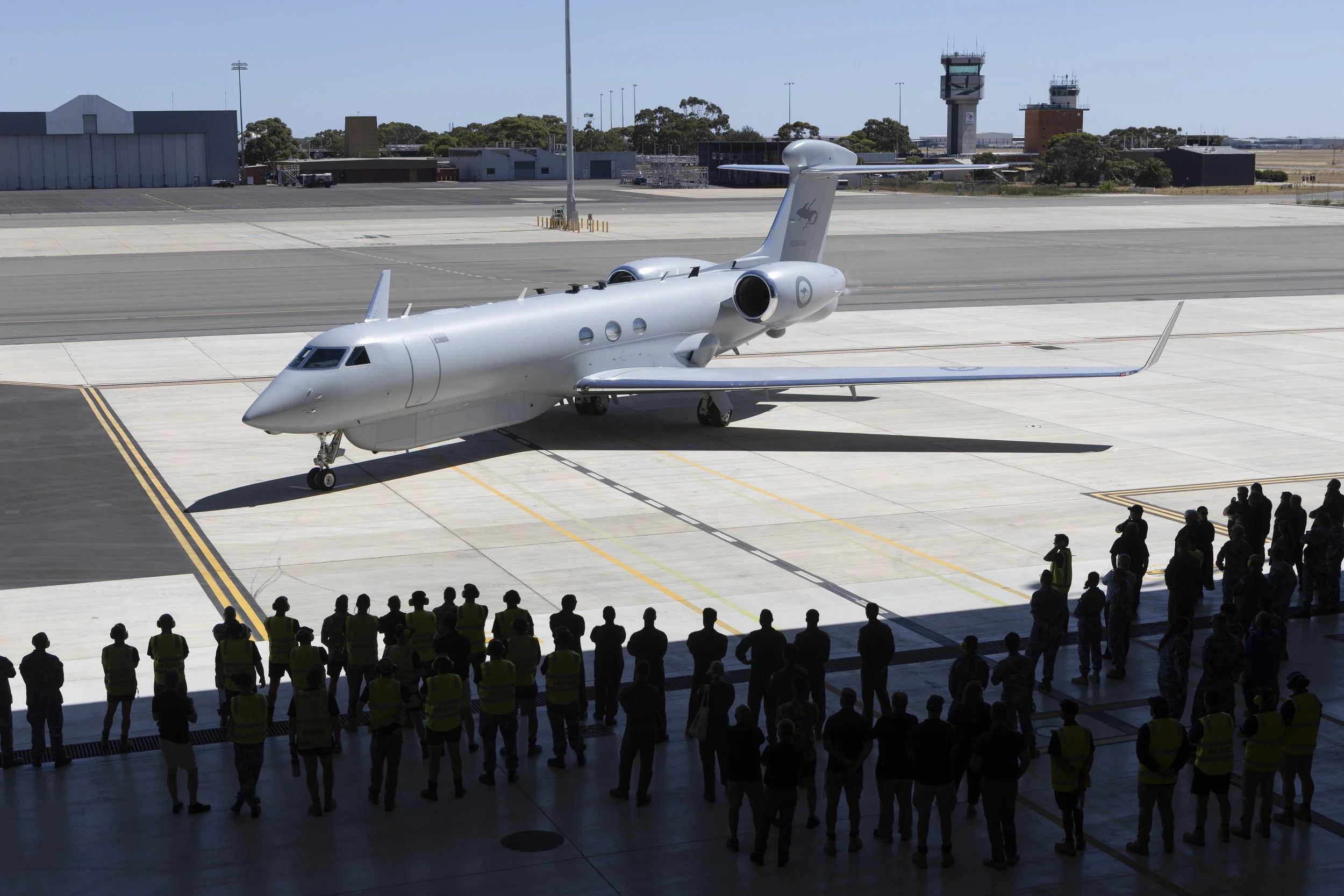
MC-55 Touches Down in Adelaide
Article by Nate Newman
Images by Australian Defence Force
RAAF Base Edinburgh has officially welcomed the first of four MC-55A Peregrine aircraft into Royal Australian Air Force service, marking a major milestone in the development of Australia’s sovereign airborne intelligence, surveillance, reconnaissance, and electronic warfare capability. The arrival of the aircraft represents one of the most significant enhancements to the ADF’s intelligence collection and battlespace awareness in decades, reflecting the growing importance of information dominance in modern military operations.
The MC-55A is based on the Gulfstream G550 business jet, a proven long-range, high-altitude platform widely used by military operators around the world. For the Peregrine program, the airframe has undergone extensive modification by US defence contractor L3Harris, transforming it from a corporate jet into a highly specialised ISR platform. These modifications support a broad range of intelligence-gathering tasks and are designed to allow the aircraft to operate at significant stand-off distances while maintaining persistent coverage over large areas. According to Defence, the MC-55A will “strengthen Australia’s sovereign intelligence, surveillance, and electronic warfare capability and ensure our Defence Force is prepared for the challenges of tomorrow.”
The aircraft was ordered in 2019 as part of a broader effort to modernise and diversify the ADF’s intelligence and surveillance fleet. Its introduction coincides with the re-activation of No. 10 Squadron, a unit with a deep and proud history in patrol and surveillance roles. 10 Squadron previously operated the AP-3C Orion, supporting maritime patrol, overland ISR, and coalition operations for many years. The transition to the MC-55A represents a fundamental shift in capability, moving from a turboprop maritime patrol aircraft to a high-performance jet optimised for electronic intelligence, signals collection, and information fusion in contested environments.
Externally, the MC-55A Peregrine is immediately recognisable by a range of prominent structural modifications to the standard G550 airframe. These include under-fuselage fairings, sensor housings, and numerous antenna arrays positioned around the aircraft to support its mission systems. While many details of the aircraft’s onboard equipment remain classified, these features highlight the Peregrine’s role in monitoring, collecting, and exploiting activity across the electromagnetic spectrum. The aircraft is expected to operate as part of a broader intelligence network, contributing data to joint and coalition command-and-control systems in real time.
Despite arriving in Australia carrying the US civilian registration N584GA, the aircraft has already been painted in full Royal Australian Air Force livery and carries No. 10 Squadron markings. It is expected to be re-registered in the A54 serial range prior to entering operational service. Initial activities will focus on system integration, airworthiness certification, and the training of aircrew and mission specialists, ensuring the aircraft and squadron reach full operational capability safely and effectively.
Once operational, the MC-55A Peregrine is expected to play a key role in both regional and global operations. The aircraft will likely be a regular participant in major exercises such as Exercise Pitch Black, where its ability to collect and distribute intelligence will be critical in supporting complex, multi-national air combat scenarios. Beyond exercises, the Peregrine will provide the ADF with a flexible and rapidly deployable ISR capability suitable for overseas deployments, coalition operations, and strategic surveillance tasks.
With its combination of range, endurance, advanced electronic systems, and secure communications, the MC-55A Peregrine represents a substantial leap forward for the RAAF. As additional aircraft arrive and No. 10 Squadron builds experience on the platform, the Peregrine is set to become a cornerstone of Australia’s intelligence and electronic warfare capability, ensuring the ADF remains well-positioned to operate effectively in an increasingly complex and contested strategic environment.